
On January 8, 2026, a research team led by Professor Han Junhai from the School of Life Science and Technology at Southeast University and the Key Laboratory of Developmental Genes and Human Disease published a research paper online in Nature Communications titled "The missense mutation Y65C in PQBP1 causes microcephaly and cognitive deficits through a combination of partial loss-of-function and gain-of-function effects." This study systematically elucidates the molecular mechanism by which the Y65C point mutation in PQBP1, a gene associated with X-linked intellectual disability syndrome, leads to microcephaly through a dual effect of "loss-of-function" and "gain-of-function," providing insights for the treatment of related diseases.
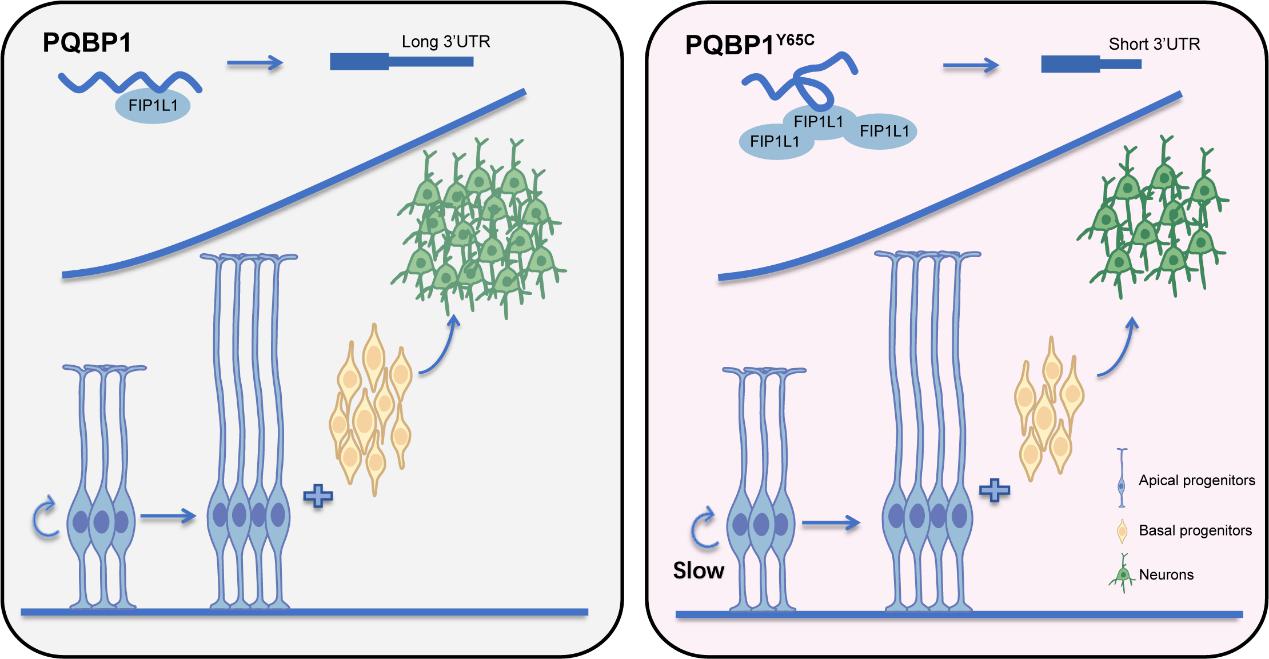
Renpenning syndrome is an X-linked genetic disorder in which patients typically exhibit intellectual disability and microcephaly. The disease is primarily caused by mutations in the polyglutamine-binding protein 1 (PQBP1) gene, with the Y65C missense mutation resulting in the most severe clinical symptoms. However, its pathogenic mechanism remained unclear. By constructing a Pqbp1Y65C/Y-KI mouse model, the research team revealed that this mutation affects brain development through a dual pathway: it causes a classical loss-of-function effect—reducing PQBP1 protein levels and thereby slowing the proliferation of neural precursor cells—while also inducing a gain-of-function effect—enhancing the binding of PQBP1 to the key regulatory factor Fip1l1, which disrupts alternative polyadenylation (APA) processes, affects mRNA maturation and stability, and ultimately leads to abnormal neuronal differentiation. This study not only clarifies the pathogenic mechanism by which the PQBP1-Y65C mutation causes microcephaly but also provides a model for understanding the pathogenic mechanisms of genetic diseases and offers insights for the treatment of related conditions.
The co-first authors of the paper are Yuan Linjuan (Ph.D. candidate), Associate Professor Cheng Shanshan, and Postdoctoral Researcher Liu Xian from the School of Life Science and Technology at Southeast University. The corresponding authors are Professor Han Junhai and Professor Zhang Zichao. This research was supported by the National Key Research and Development Program of China "Brain Science and Brain-Like Research" (STI2030-Major Projects) and the National Natural Science Foundation of China. (School of Life Sciences)
Link to the original article: https://www.nature.com/articles/s41467-025-68202-5